
St. Martin Parish Criminal History Checks
There is no official all-in-one St. Martin Parish criminal history database. Start with the question the record must answer. The St. Martin Parish Sheriff inmate channel addresses present parish-jail custody. The St. Martin Parish Clerk of Court addresses filed district-court cases, minutes, judgments, and certified copies. A city police department holds its own incident narrative. Louisiana State Police supplies a fingerprint-based self-review rather than a public name search.
Collect a full legal name, date of birth, prior names, and likely event year first. A case number, booking number, incident number, or exact arrest date sharply narrows the work. Spelling variants matter, especially when a live jail result is the first lead. Match more than a name before treating a result as the right person.
- Check the sheriff’s current inmate tool for a recent booking or present custody.
- Identify the arresting agency and request its incident or arrest report.
- Ask the clerk whether a St. Martin Parish case has been filed in the 16th Judicial District Court.
- Read the disposition and sentence from the court minutes or judgment, not from the original booking allegation.
- Order a certified court copy or obtain a Louisiana Right to Review when an official personal record is needed.
Note: A recent jail entry may appear before the district attorney makes a filing decision.
St. Martin Records Split Three Ways
St. Martin Parish is geographically noncontiguous, and its justice records are split by function as well as place. The sheriff documents arrest, booking, custody, and jail release. The clerk documents prosecution after a charge is filed. The 16th Judicial District spans St. Martin, Iberia, and St. Mary parishes, so users of shared district resources must choose St. Martin rather than assuming every 16th JDC result belongs here.
The official parish government entry point helps identify parish departments. Its captured view gives context for the local government structure behind record access.

That structure explains why one counter cannot provide a complete criminal history. Municipal police reports remain with the city, while state-police events stay with Louisiana State Police. Always identify the creating agency before sending a public-record request.
Official Background Checks in Louisiana
Louisiana is a closed-record state. The Louisiana Computerized Criminal History system, or LACCH, is maintained by the Louisiana State Police Bureau of Criminal Identification and Information, but it is not a general public name-search portal. A person may obtain their own certified fingerprint-linked record through Louisiana Right to Review. LAPS appointments use approved IdentoGO enrollment sites and can deliver a one-time electronic report link or a raised-seal copy by mail.
The official BCII material shown here explains why a local court lookup and an official state record are not interchangeable.
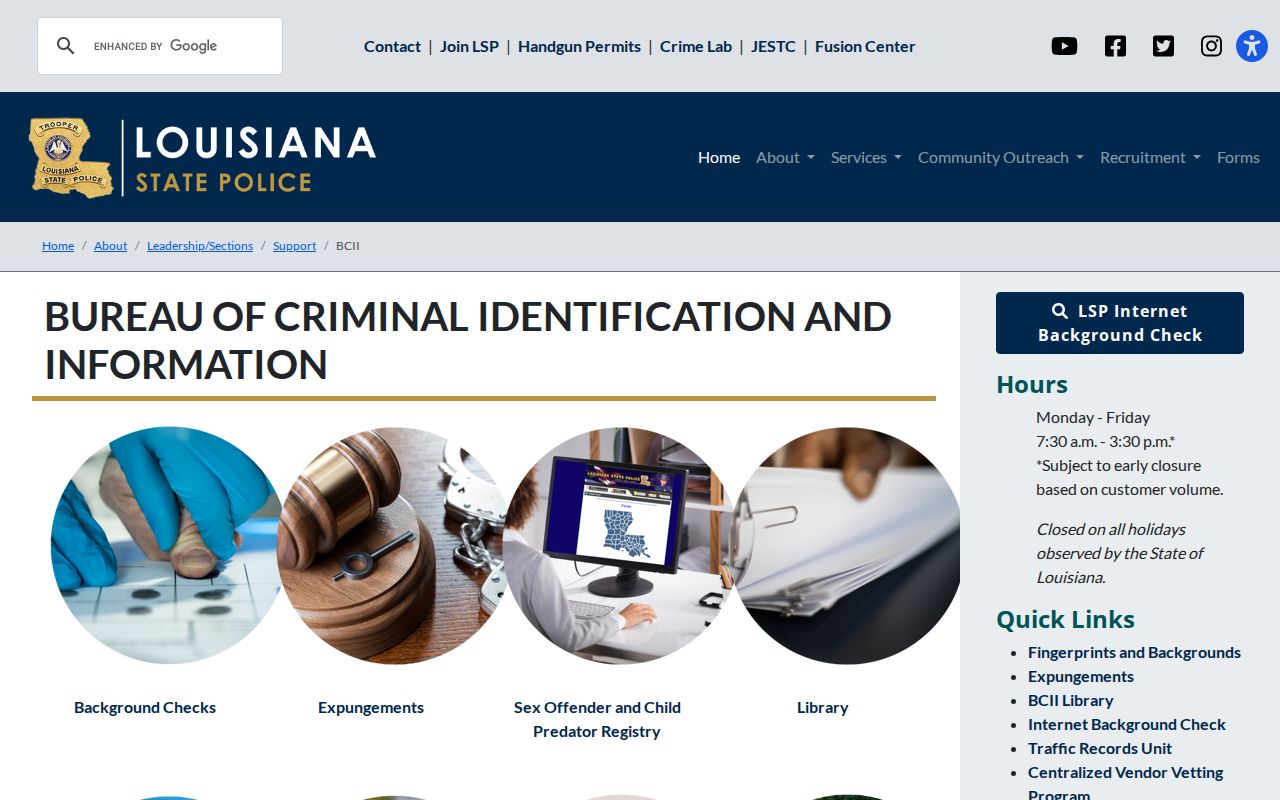
LSP does not accept criminal-background walk-ins. Its Breaux Bridge Field Office should not be treated as a civilian fingerprint center. Use the current LAPS appointment locator. Statutorily authorized checks require the proper disclosure and authorization forms; personal self-review remains the leading public route.
| Official service | Current amount | Scope |
|---|---|---|
| Louisiana state processing | $31 | Authorized request on the current LSP form |
| Authorized FBI component | $13.25 | Federal component where legally authorized |
| FBI Identity History Summary | $18 | Fingerprint-based FBI self-review |
| Clerk search or copy | Confirm with clerk | One St. Martin Parish case file, not a rap sheet |
How St. Martin Criminal Booking Data Flows
An arresting officer creates the first report. If the person enters the parish jail, intake staff confirm identity and authority, inventory property, perform screening, take fingerprints and a photograph, and enter alleged charges and hold data. Fingerprints are associated with a State Identification number through Louisiana’s fingerprint system and feed a LACCH arrest cycle. A judge adds first-appearance or bond material. Later, the district attorney decides whether and what to file.
The court process is a separate stage: Arrest report → Jail booking → Fingerprint submission → Charging decision → Clerk case → Disposition → Corrections update. A dismissal in court does not by itself remove the arrest cycle. Delayed or unmatched dispositions are one reason LSP recommends reviewing the state record before seeking correction or expungement.
Kinds of Criminal Records
Each St. Martin Parish criminal record answers a limited question. An arrest report describes an officer’s action and alleged basis. A booking record describes jail intake and custody. A filed case records prosecution and the court’s rulings. A warrant is an order from a named court or judicial officer. Probation, parole, imprisoned-person, and registry records are kept in separate state or local systems.
- Arrest and incident reports come from SMPSO, a municipal police department, LSP, or another arresting agency.
- Booking and custody entries come from the facility that accepted the person.
- Criminal case files come from the St. Martin Parish Clerk for filed 16th JDC matters.
- State criminal history is fingerprint-linked in LACCH and available to the subject through Right to Review.
- Registry records come from the Louisiana registry and parish OffenderWatch interface.
The 16th Judicial District Court’s official site identifies the court structure that handles district-level St. Martin Parish cases.
The district view is essential, but it does not replace city-court channels for ordinance, citation, or municipal bench matters.
Older St. Martin Criminal Files
The parish seat in St. Martinville remains important for historical criminal records. Louisiana clerks retain paper and image files even when a newer docket index offers remote access. For an older case, give the clerk the defendant’s name, approximate arrest or filing year, and case number if known. Ask whether the record is onsite, imaged, archived, or restricted.
The St. Martin Parish Clerk of Court site is the authoritative starting point for current access and contact details.
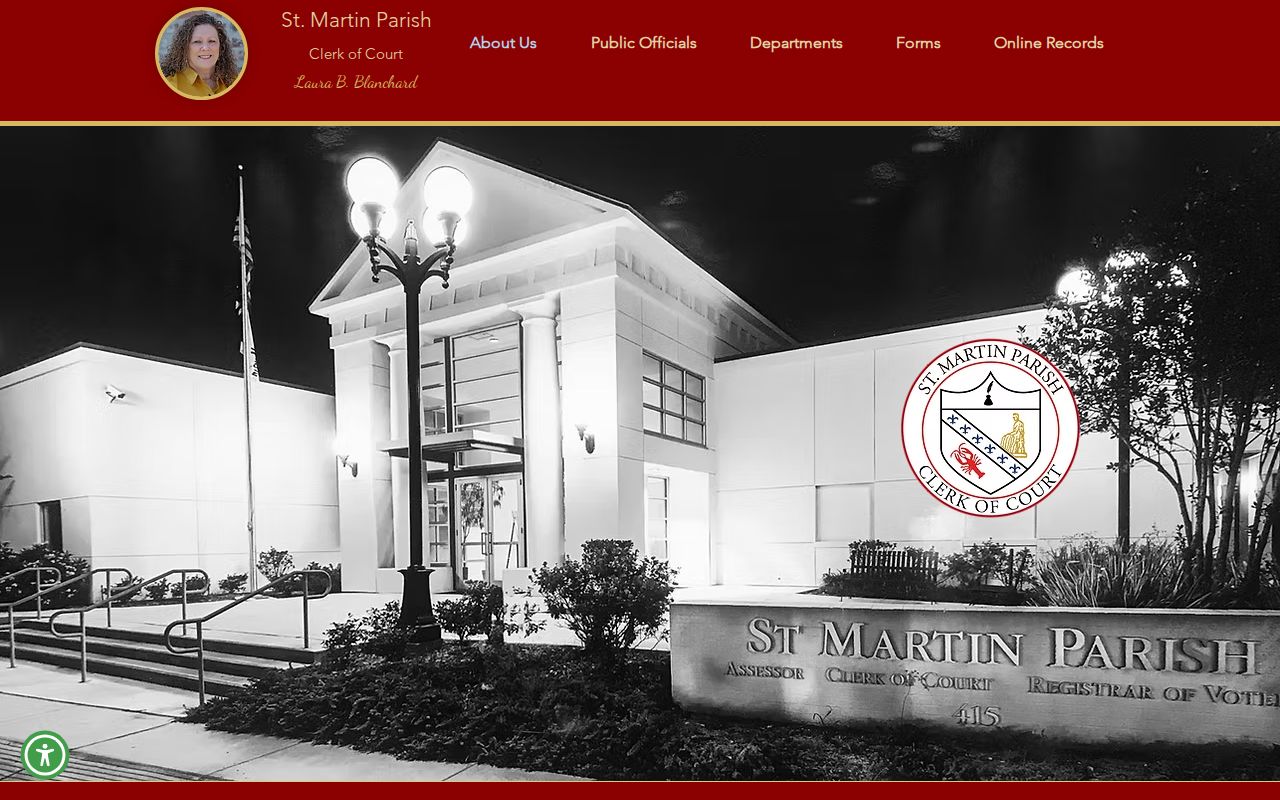
Before traveling, confirm counter hours, acceptable payment, building security, access needs, and whether the file must be retrieved. The sources reviewed did not support a specific counter room, parking rule, or prohibited-items list.
St. Martin Parish Criminal Records: What They Contain
Reading a criminal history requires separating identifiers from allegations and final outcomes. A name match alone is weak. Use birth information, agency, dates, and record numbers to confirm identity. Then locate the court disposition, because the charge at booking may be amended, rejected, dismissed, or resolved under a different statute.
| Name & Identifiers | Legal name, aliases, date of birth, physical descriptors, agency numbers, and a state identification number where lawfully shown. |
|---|---|
| Arrest / Booking Data | Incident and booking numbers, arrest and intake dates, arresting agency, photograph if enabled, bond, hold, and release or transfer status. |
| Charges & Statutes | Alleged booking offenses, later filed counts, statute citations, count numbers, and amendments. |
| Disposition | Dismissal, acquittal, plea, conviction, nolle prosequi, or another recorded result. |
| Sentence | Imprisonment, suspended time, fines, probation, conditions, and credit where recorded. |
| Custody / Supervision | Parish-jail status, state imprisonment, probation, parole, or a detainer, subject to public-access limits. |
- Nolle prosequi
- A prosecutor’s decision not to proceed with the filed charge at that time. It does not erase the booking.
- Disposition
- The court-recorded result of a charge.
- Capias
- A court order used to bring a person before the issuing court, often tied to a missed appearance or order.
- Expungement
- Louisiana’s process for making an eligible record confidential. It does not physically destroy the record.
St. Martin Custody Records Versus Outcomes
SMPSO’s “Find an Inmate” route is the proper first check for present parish-jail custody. A missing name can mean release, transfer, delayed posting, or a spelling mismatch. The jail profile may show a booking date, agency, alleged charges, bond, and status. It does not supply the complete police narrative or final court judgment.
For a person who has left the live roster, the sheriff’s Letter of Incarceration form can verify confinement for a named date or range. State-sentenced custody belongs in the Louisiana DPS&C Imprisoned Person Locator.
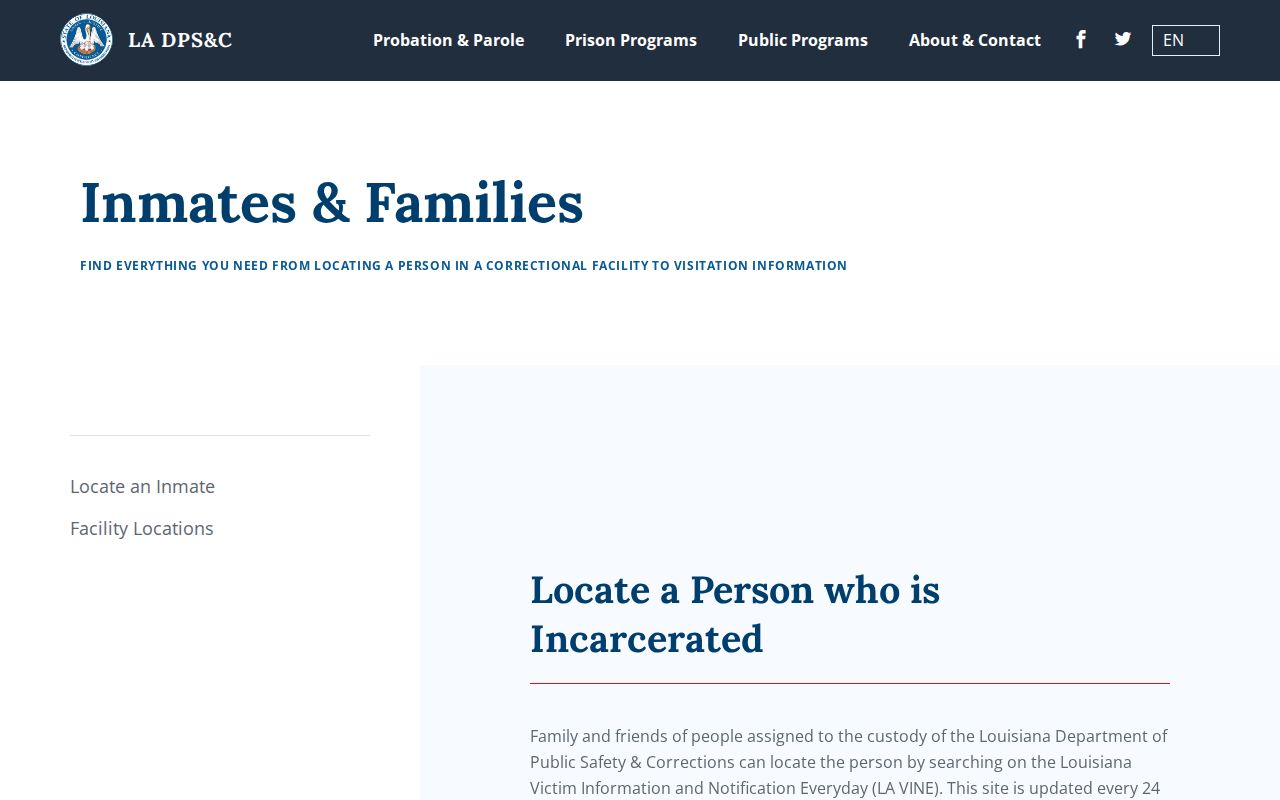
That state tool covers DPS&C custody, not the St. Martin Parish jail. Louisiana VINELink adds custody notifications, while the clerk remains the source for the sentence itself.
Louisiana Public Access Laws
The Louisiana Public Records Law generally requires a custodian to permit access to public records during regular office hours. It does not make every police detail public. Active-investigation material, confidential sources, security procedures, juvenile information, protected victim data, medical material, and personal identifiers may be withheld or redacted. A focused request should list the incident or booking number, subject, date range, location, desired format, and the agency that created the record.
Key Statutes:
La. R.S. 44:1 defines public records and the offices subject to Louisiana access law.
La. R.S. 44:3 protects specified law-enforcement and investigative material.
La. C.Cr.P. art. 973 states the effect of expungement and preserves limited authorized access.
La. R.S. 15:542 establishes sex-offender registration duties.
Ask for an estimate before copies are made. If access is denied, request the legal basis. An open-record request is not a demand that an office create a new criminal-history summary.
Route St. Martin Parish Record Requests
A parishwide request sent to the sheriff can miss city-generated material. Breaux Bridge Police holds its reports. St. Martinville Police holds its reports. Parks Police holds village reports it created. Louisiana State Police handles trooper events. The sheriff holds SMPSO reports and parish-jail records, while the clerk holds the filed judicial case.
Parish Jail and Sheriff Records
SMPSO Main Offices & Corrections
400 Saint Martin Street
St. Martinville, LA 70582
Use the current official contact route.
District Court Files
St. Martin Parish Clerk of Court
St. Martinville courthouse
Confirm address, phone, hours, and copy cost before visiting.
State Self-Review
Louisiana State Police BCII
Schedule fingerprints through LAPS
No criminal-background walk-ins.
Keep the request narrow. An event date, place, incident number, person’s full name, and requested format help the custodian locate responsive material and identify any lawful redactions.
Restricted, Sealed & Expunged Records
Juvenile records and sealed filings are not ordinary public records. Louisiana expungement also differs from physical destruction. An eligible order makes the record confidential, while Article 973 preserves access for defined criminal-justice purposes, the subject or counsel, court-ordered good cause, and certain listed bodies.
For a St. Martin Parish matter, begin with a Right to Review so the arrest date, agency, charge, and booking identifiers match LACCH. Use the current uniform Article 986 forms and file in the parish of arrest or conviction, generally through the St. Martin Parish Clerk for a 16th JDC matter. The current LSP expungement fee is $250 unless a valid waiver applies. Confirm the full local filing total with the clerk.
After an order is signed, verify both court visibility and the state record. Processing is not instant. If an eligible record remains visible, send the certified order to the reporting custodian and ask for correction.
St. Martin Warrant Checks Need Layers
No complete official parishwide public warrant database was confirmed. Contact SMPSO for sheriff-held warrant information. Ask the 16th JDC clerk about a case-linked capias. For a municipal citation or bench matter, contact the court that issued it. The inmate list is not a warrant list, and absence from custody does not prove that no warrant exists.
Ask for the issuing court, docket number, stated charge, bond or hold, and confirmation that the order remains active. Search warrants and sealed arrest warrants are generally not public before execution. A person seeking to resolve their own suspected warrant should consult the issuing court or counsel before appearing. Never try to detain another person.
St. Martin Criminal Data Needs Context
The FBI Crime Data Explorer can provide agency-level trends, but the agency and year must be selected correctly.

St. Martin Parish contains sheriff, city, state, and other enforcement jurisdictions. One agency’s return is not a parish total. A blank or missing year must not be called zero crime, and reported incident totals do not state how a specific arrest ended. Use the clerk’s disposition for the case outcome.
City-by-City Criminal Records in St. Martin Parish
City police departments create their own reports, and municipal or city courts retain local dockets. The 2024 whole-city Census ranking places cross-parish Broussard first, followed by Breaux Bridge and St. Martinville. Broussard’s figure includes the full city across the St. Martin and Lafayette parish line, so confirm the event parish before choosing a jail or district clerk.
Broussard Record Check
15,312 whole-city estimate · BPD reports and magistrate records use city channels; the parish line can change booking and court routing.
Breaux Bridge Record Check
7,582 · City police reports remain local, while accepted parish bookings and filed 16th JDC cases use parish offices.
St. Martinville Record Check
5,229 · City police, mayor’s court, parish jail, and district clerk maintain distinct records in the parish seat.
Use the city page for the first local contact, then move to the sheriff or clerk only when the record itself moved into parish custody or district court.
St. Martin Registry Results Versus Criminal History
The Louisiana State Sex Offender and Child Predator Registry is a public-notification system, not a full criminal-history search. SMPSO links the parish OffenderWatch interface, and the U.S. Department of Justice NSOPW adds a cross-state layer. A registry result can show qualifying offense and registration details, but it does not replace the underlying St. Martin Parish court judgment.
Address and compliance data can change. Report a suspected stale address or violation to SMPSO or Louisiana State Police rather than confronting anyone. Registration information may not be used to threaten, harass, or retaliate.